
Barrier island garage doors
Garage Door Repair in Indian River Shores, FL
Indian River Shores is a barrier island town between the lagoon and the Atlantic, with oceanfront and lagoon-front homes and salt air in every season. Garage doors here face harder conditions than doors a few miles inland. ASAP Garage Door Services helps owners understand corrosion, wind and daily wear, and explains how to plan a repair or a replacement by phone.
Area service guide
Garage Door Repair in Indian River Shores, FL: what to know
Salt air on the barrier island: the slow enemy of garage door hardware
On a barrier island, salt is not an occasional visitor but a constant presence. Fine mist rides the breeze off the Atlantic and drifts across the lagoon, settling on everything with a metal surface. Garage doors have plenty of exposed steel, including springs, cables, bottom brackets, hinges, track fasteners and the bolts that hold the opener rail. Over time that coating of salt draws in moisture and encourages rust, even on parts that look healthy from a few feet away. The effect builds quietly, season after season, until a part finally gives way.
The door skin may be painted or coated, but the hardware behind it often receives much less protection. Zinc coatings on fasteners and cables wear off faster in a salty setting, and once bare steel is exposed the corrosion moves quickly. Springs can lose their finish and then crack at the ends of the coil. Cables can rust internally and shed strands at the bottom bracket. Rollers with steel bearings may seize and then drag along the track, creating noise and extra load. Oceanfront owners sometimes assume only the street-facing side suffers, but lagoon-front garages see the same fine mist on a breezy afternoon. Do not treat either side of the island as protected from corrosion.
For owners of oceanfront and lagoon-front homes, regular attention is the best defense. A soft cloth wiped along the tracks and a gentle rinse of the lower panels can remove surface salt. Looking for rust blooms at brackets and hinges takes only a minute. When you call, tell us how close you are to the water and how long the door has been in place, because those facts help us gauge which parts to prepare. Owners of newer homes should not assume they are safe either, because even recent hardware begins to show surface rust within a few seasons when it is left untouched.
Springs and balance on heavier, higher-end doors
Many homes on the island carry larger garage doors, often with decorative panels, windows or wood-look finishes that add weight. A heavier door puts more demand on the spring system, and the springs must be sized correctly for that weight. A spring that was fine for a plain steel door may not be right after an owner adds glass or insulation. When springs are under or over strength, the door will not stay balanced, and the opener will carry load it was never meant to bear. Always mention windows, insulation or a custom finish when you describe the door, since each one changes the weight the springs must carry.
You can test balance in a general way. With the door closed, pull the release cord to disconnect the opener, then lift the door by hand to about waist height. A balanced door tends to stay in place, while a poorly balanced one drops or flies upward. Do this only if you are comfortable and the door is in good shape, and never if you suspect a broken spring. When in doubt, call and describe what you see instead of testing. If the door feels heavier than it did last year, that is useful information for us even if nothing has visibly broken.
Replacing springs is work for a trained technician. Winding bars, tension and torque are all part of a job that can injure someone who tries it casually. Corroded spring ends and rusted center brackets are a frequent find on coastal homes, and the technician will usually inspect the whole spring assembly. Springs are often replaced as a matched pair, and the bar, bearings and brackets are checked at the same time. Never use a ladder to inspect the spring above a closed door while the opener is connected, because a sudden movement can be dangerous.
Cables, drums and the lower corners that rust first
If you want to know where a coastal garage door is most likely to fail, look at the bottom corners. Water runs down the door face, collects near the floor and sits against the bottom bracket. Salt joins it, and the combination is hard on steel. The lift cable attaches at the bracket, so rust at that spot weakens the cable at its most stressed point. A frayed cable can snap with little warning and leave the door hanging or crooked. A cable pulled tight against a rusted drum groove can cut itself in half over time, even though the outside of the door looks fine.
Signs of trouble include rust stains below the bracket, a door that tilts when it moves, or small wires sticking out of the cable. Some owners notice a slight shudder as the door passes a certain point. Others hear a faint snap. None of these should be ignored. Running the opener against a damaged cable invites bent tracks, scraped panels and a heavier repair. Stop using the door, keep people clear, and call for guidance. Photographs of the rust stains help, but please take them from a safe distance and do not touch the cable under tension.
On a service visit, the technician looks at both cables, both drums and both brackets. The drums can wear or rust, and a misaligned drum can chew the cable. Replacing cables without checking the drums may only fix part of the problem. We will describe what we see in plain terms so you can decide whether to replace the pair, update the brackets or take on additional hardware work. Fixing these parts together usually restores smooth travel and takes strain off the opener, the springs and the rollers.
Tracks, rollers and hinges on windy ocean days
Wind on the island is not just a storm matter. Steady breezes push on a garage door every day, and gusts can flex panels and rattle the hardware. Over time, track fasteners can loosen, rollers can wear and hinges can develop play. A track that has shifted even slightly can make the door scrape or bind. Because the door is so large, small misalignments show up as noise, uneven movement or a door that no longer seals evenly at the floor. Heavier custom doors make the problem more noticeable, since extra weight loads each roller and hinge more than a lightweight panel would.
Rollers deserve special mention. Nylon rollers resist rust but can crack, and steel rollers can rust in place. Either type should turn freely and sit snugly in the track. A worn roller will let the door wobble, and that wobble multiplies stress at the hinges. Replacing a full set of rollers is usually a reasonable maintenance job on an older coastal door, particularly when several are visibly tired. If you hear a squeal near the same point in every cycle, tell us where on the track it happens, because that points to a specific roller or a bend.
Lubrication helps, but only the right kind in the right places. A light spray on hinges and roller stems can quiet movement, while tracks are typically wiped clean rather than greased. Salt and sand cling to grease and form a gritty paste. If you are unsure, ask us during the call. We can tell you what is safe for a homeowner to do and what should wait for a technician. Sand blown across the driveway and into the garage also works its way into the tracks and speeds up roller wear.
Openers, sensors and the convenience that runs every day
Garage openers on the island often work hard. Owners leave for work, return from the beach, bring in groceries and welcome guests, and each trip uses the opener. Moist, salty air can affect the circuit board, the wiring and the sensor connections. Corroded terminals can cause intermittent trouble that comes and goes, which is more annoying than a simple failure. A door that sometimes works and sometimes does not often points to a connection or a sensor. Moisture inside a circuit board can cause odd behavior, such as lights flashing or the door starting on its own.
Safety sensors protect people and property. They sit near the floor on either side of the door and send an invisible beam across the opening. If one is knocked, dirty or corroded, the door may refuse to close. Check that both lights are steady and wipe the lenses gently. Make sure the brackets are tight and not rusted through. Keep the area clear of stored items, since a bin leaning near a sensor can block the beam. A technician can test the wiring and the wall control to see whether the fault is in the opener or in a loose connection.
If the opener groans or the door moves unevenly, the cause may not be the opener at all. A weak spring or a worn cable can make the door feel heavy, and the opener strains to compensate. Replacing the opener without addressing the door only shortens the life of the new one. A technician will check the door first, then judge whether the opener needs service or replacement. If your opener is quite old, ask whether a replacement offers quieter operation and updated safety features.
Remotes, keypads and smart access for busy households
Many homes on the island use garage access as the main entry. Remotes live in cars, keypads sit on exterior walls, and smart controls link phones to the opener. Each of these has its own weak point. Batteries wear out, keypad buttons corrode and wireless modules lose their connection. If your remote has stopped working, replace the battery before anything else, then try the wall button. The result tells us whether the transmitter, the receiver or the opener is at fault. Smart controls depend on a stable wireless signal, and a metal garage or thick walls can weaken it.
Exterior keypads face the weather more than anything else. Direct sun and salt air can fade the display, loosen the buttons or let water into the housing. Replacing a keypad is usually a simple job, and reprogramming takes only a few minutes. Consider a spare remote kept inside the house so you can still enter if a vehicle remote is lost or left behind. If a phone app stops working, check the home network and the opener power before assuming the opener has failed.
Security matters too. Older openers with fixed codes are easier to copy than newer rolling code systems. If your system is older, ask whether an update makes sense. Also remember to clear remotes from the opener memory when a vehicle is sold or a tenant moves out. We can talk through these details when you call, and a technician can handle programming during a visit. When we program devices, we ask the owner to be present so access codes remain in the right hands.
Battery backup and the manual release before a storm
Power can fail on the island during storms, and a garage door that cannot open may trap a vehicle inside or block it from leaving. A battery backup unit lets many openers keep running through an outage. Not all openers support one, and some models include it as a built-in feature. If you want to add backup, mention your opener brand and age when you call, and we will explain what is realistic. Charge status matters too, since a backup battery that has aged may not hold enough power to lift the door.
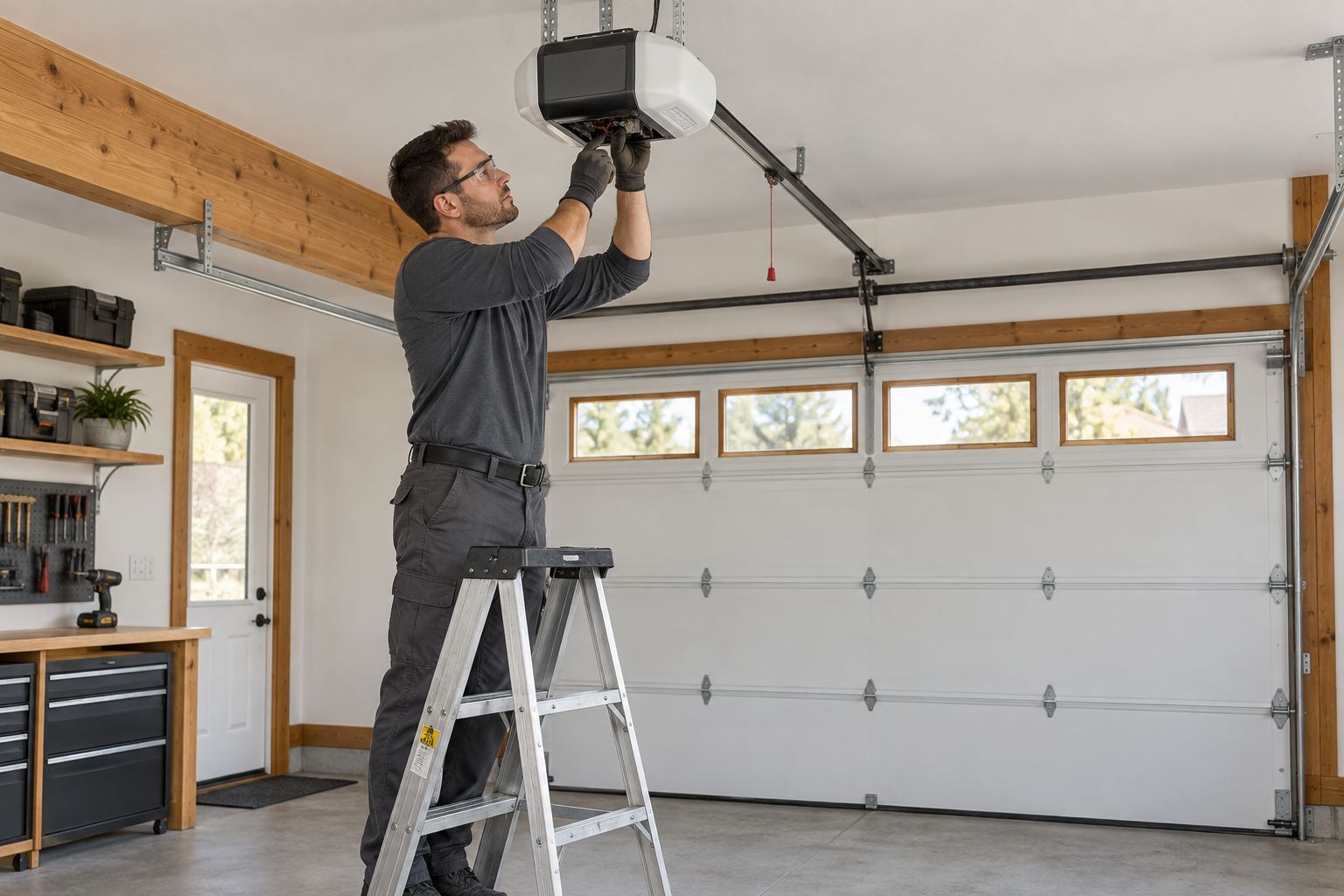
Without backup, you rely on the manual release. A red cord hangs from the trolley on the opener rail. Pulling it disconnects the door from the motor so the door can be lifted by hand. This works only when springs and cables are in good order. A door with a broken spring will be too heavy, and trying to lift it can strain muscles or drop the door. Know the limits before you depend on it. Ask your technician how long the battery is expected to last and when it should be replaced.
Practice before storm season rather than during it. Learn how to disconnect, lift and reconnect the door, and show another adult in the household. Reconnecting usually involves lining up the trolley and letting it catch as the opener travels. If the cord is frayed or the handle is missing, have it replaced. It is a small repair that helps in a very stressful moment. Keep the area near the opener clear so the release cord can be reached quickly without a ladder or stool.
Wind-rated and impact-rated doors in general terms
Homes on a barrier island face the strongest wind during tropical systems, which is why many owners consider wind-rated or impact-rated garage doors. These doors are designed with heavier sections, reinforced struts and stronger hardware to resist wind pressure and flying debris. They are built as systems, with tracks, brackets and fasteners suited to the load. A standard door is a large, relatively lightweight surface, and it can bow, buckle or pull out of its tracks under strong wind. Marketing language varies between manufacturers, so rely on a technician to explain what a specific product offers and what it does not.
Choosing a stronger door involves more than a single feature. The opening must be sound, the framing must be solid and the attachment points must be right for the hardware. Look at how the door interacts with the rest of the home, since the garage is often the largest opening in the building envelope. We can describe general differences by phone, and a visit can look at the opening, the framing and the existing door. Replacement of the entire door, tracks and hardware together is often cleaner than adding a single reinforced panel.
If you are replacing a door anyway, it is a good moment to think about storm performance. If you are not ready to replace, regular maintenance still helps by keeping tracks, fasteners and seals in good condition. A tired door with loose hardware is more vulnerable than a well maintained one. Ask about your options, and decide at a pace that feels comfortable. Keep in mind that a stronger door still needs maintenance, since salt and moisture will attack its hardware as well.
After the storm: what to inspect before touching the opener
After a major wind event, the garage door can look fine while hiding damage. Tracks may have shifted, brackets may have loosened and panels may carry hairline creases. Before you press the button, take a careful look. Check that the door sits straight in the opening, the tracks are parallel and the cables are in place. Look for bent hinges, cracked windows and gaps along the sides where the seals have pulled free. If water has entered the garage, keep clear of the opener and any outlets until the area is dry and safe.
Debris is common after a storm. Palm fronds, sand and small items can lodge in the tracks or near the sensors. Clear what you can reach safely from the floor, and never put your fingers near the tracks or hinges. If the door will not move, or moves unevenly, do not force it. A damaged door can drop without warning, and a bent track can bind with enough force to injure someone. Taking photos of any damage before cleanup may help with your own records or insurance questions, which we cannot advise on.
Call and tell us what you saw. If the door is off track, hanging crooked or partly open, describe it carefully, and stay clear of the opening. Please also tell us whether the home has power and whether the garage is flooded, because water around the opener raises extra safety questions. We will explain what a visit involves and confirm availability and the service area. Resist the temptation to test the door repeatedly, since each attempt can add wear to a damaged part.
Condos, associations and rental properties on the island
Not every home on the island is owner-occupied, and many belong to communities with their own rules. Associations may regulate door color, window style and hardware, and some require approval for replacement. Check your governing documents before ordering anything. A like-for-like repair often needs less approval than a full replacement, but each community differs. A short call to the manager can prevent delays. Properties managed by a company often have a preferred process, so ask for it before work is arranged.
If you rent or manage a rental, make clear who authorizes the work. Some leases put garage door repairs on the landlord, while others split responsibility. Provide a contact who can approve a quote and give access to the garage. Seasonal homes pose their own challenge, since a door may sit unused for months and fail the first time it runs again. Have someone check the door before the owners arrive. If you travel often, share contact details for someone who can open the garage and speak with the technician.
Shared garages and common-area doors involve a manager or board, and the work may need approval from more than one person. When you call, tell us whether the door is private or shared, who has authority and how access will be arranged. This helps plan the visit and keeps the process clear for everyone involved. Clear communication between owner, tenant and association is the best way to keep the repair simple.
Planning your call and weighing repair against replacement
Before you call, gather the basics. Know your address, what the door is doing, when the trouble began and any sounds or smells. If possible, note the door brand, the number of springs and the make of the opener. Please ask us to confirm availability and the service area, because we do not want you to plan around something we cannot confirm. A few minutes of preparation makes the call faster and the visit smoother. Keep an old receipt or a photo of the label inside the door if you have one, since it identifies the model quickly.
Simple jobs may be quoted by phone. A complicated job, such as a full replacement or a door in an unusual opening, needs a visit so the technician can measure and inspect. The service call charge is explained before dispatch, which keeps the process clear. You will hear what the technician finds and what it means before extra work is done, and you decide whether to go ahead. Ask us any question, big or small, before you decide, and take your time making the choice.
Repair or replace depends on age, condition, frequency of past repairs and how you use the garage. A newer door with one broken part is a good repair candidate. An older door with rusted sections, bent tracks and a tired opener may be better replaced as a set. On the island, the effect of salt air is a strong reason to replace corroded hardware, so ask the technician to explain what is worth keeping. A planned replacement is almost always calmer than one arranged after a failure in the middle of storm season.
Common questions about Garage Door Repair in Indian River Shores, FL
Why do garage doors rust so quickly on the barrier island?
Salt carried by the breeze settles on exposed steel and attracts moisture, which speeds up rust. Springs, cables, brackets, hinges and fasteners are the usual trouble spots. Wiping tracks, rinsing lower panels gently and checking for rust regularly help you find problems before parts fail or the door becomes unsafe.
Can I adjust my garage door springs to fix a heavy door?
No. Springs store a lot of energy, and adjusting them without the right tools and training can cause serious injury. A heavy door often points to a worn or broken spring, and the proper fix is replacement by a technician. Stop using the door and call us to describe what you see.
What should I do before a tropical storm?
Check that tracks are secure, rollers turn freely and seals are in place. Learn how to use the manual release and show others in the household. Clear loose items from the garage. After the storm, inspect the door before using the opener and call us if anything looks bent or out of square.
Should I consider a wind-rated or impact-rated door?
These doors use stronger sections and hardware to resist wind pressure and debris. Whether one suits your home depends on the opening, the framing and your priorities. We can explain the general differences by phone, and a visit can look at your existing door and opening before you decide. Ask about what the technician will inspect so you know what to expect.
How do I get a quote and confirm that you serve my address?
Call us with the address, the problem and the door details. Simple jobs may be quoted by phone, while a complicated job needs a visit. The service call charge is explained before dispatch. Please ask us to confirm availability and that your Indian River Shores address is within our service area.
Ready to talk through the door?
Call ASAP Garage Door Services
Describe the symptoms and property access for Indian River Shores so the team can discuss scheduling and the next appropriate step.